
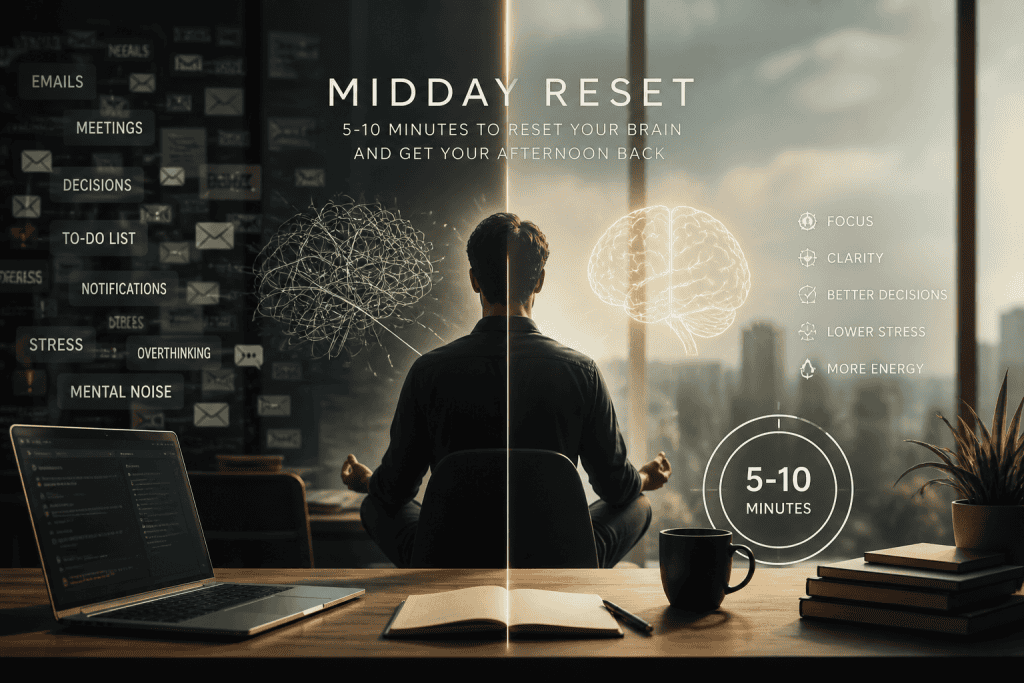
Most people think meditation is something you do in the morning, maybe before your coffee, when everything is quiet and ideal. In reality, that’s not where most people struggle.The real drop happens in the middle of the day.You’ve already made decisions, taken calls, processed information, maybe dealt with stress or emotional friction. By early afternoon, your brain is not fresh anymore. It’s loaded. That’s where performance quietly declines and it is clear that our focus slips, small decisions feel heavier, and you start compensating with caffeine or pushing through.A short, well-structured 5–10 minute reset at that point is not about “relaxing.” It’s about restoring how your brain is functioning.
Why Midday Is the Real Leverage Point
By the time you hit midday, a few things are already happening physiologically.
Your prefrontal cortex which is the part responsible for focus, planning, and impulse control is starting to fatigue. Cortisol, which helps maintain alertness, naturally dips. On top of that, cognitive load accumulates. You’re carrying unfinished thoughts, micro-stressors, and background noise.
You can feel it, even if you don’t label it that way:
- it’s harder to concentrate
- you switch tasks more often
- your tolerance for stress drops
This is exactly where a short intervention has the highest return. Not because it’s dramatic, but because it interrupts a downward trend.
What’s Actually Happening in the Brain
There’s a tendency to oversell meditation, so it’s worth being precise.
A 5–10 minute session is not rewiring your brain overnight. What it can do, consistently, is shift how certain networks are behaving at the moment.
One of the main targets is the default mode network. This is the system involved in internal chatter like thinking about the past, anticipating the future, low-level rumination. When it’s overactive, you feel distracted even if nothing external is happening.
Short mindfulness practices have been shown to reduce activity in this network, even in brief sessions. The practical effect is simple: less mental noise, easier return to the task in front of you.
At the same time, attention networks, especially in the prefrontal cortex, become more engaged. This is where you get improvements in sustained attention and reduced error rates in cognitive tasks. Not massive changes, but noticeable if you’re paying attention to your own performance.
There’s also a shift in the autonomic nervous system. Most high-performing professionals operate in a mild but chronic sympathetic state, slightly “on edge,” even if it feels normal. A short reset nudges the system back toward balance, which paradoxically improves energy efficiency rather than making you sleepy.
What the Evidence Actually Supports
Short mindfulness interventions, sometimes as brief as 5–10 minutes, have been associated with:
improved attention and task accuracy
reduced mind-wandering
better emotional regulation under stress
However, this only holds when expectations are realistic.
This is not a replacement for sleep. It’s not a cure for burnout. It’s not going to suddenly make you hyper-focused after one session.
The real benefit comes from using it consistently at the right moment when your performance is already declining.
A Simple 5–10 Minute Protocol That Works
This does not need to be complicated.
Sit upright. No need to lie down. Set a timer for 5 to 10 minutes.
Bring your attention to your breath, but not in an abstract way. Focus on something specific, like the sensation of the exhale or the air moving through your nose.
Your mind will wander. That’s expected. The moment you notice it, bring it back. That act, returning attention is the actual training.
You don’t need music, visualization or a fancy app unless it genuinely helps you stay consistent. Most of the time, those become distractions.
If you finish and feel exactly the same, that’s fine. The effect is subtle. What matters is whether your next hour is cleaner, more focused, less fragmented.
Where Most People Get It Wrong
The biggest mistake is treating this like passive relaxation.
Scrolling, lying down or closing your eyes and drifting is not the same thing. That doesn’t train attention.
Another mistake is inconsistency. Doing this once or twice when you’re already overwhelmed won’t show much. Doing it daily, even when you don’t feel like you “need it,” is what builds the effect.
Overcomplicating it is another issue. The more steps you add, the less likely you are to actually do it in the middle of a real day.
How to Use It in a High-Performance Routine
Think of this as a reset between cognitive blocks.
Ideal times:
- early afternoon dip
- after a long meeting or clinic session
- before starting a second work block
Instead of pushing through fatigue, you pause briefly, reset, and then re-engage.
If you’re consistent, you’ll notice something subtle but important: your afternoons stop feeling like something you have to “get through.”
Important to note:
A 5–10 minute midday meditation is not about becoming calm or “mindful” in a vague sense.
It’s a targeted way to reduce mental noise, restore attention, and maintain cognitive performance across the day.
It’s simple, but not optional if you’re trying to operate at a high level consistently.

Future Psychiatry is a concierge practice in New York City specializing in integrative psychiatry, anxiety treatment, and holistic mental health. Founded by Jafar Novruzov, PMHNP-BC, the clinic provides luxury, evidence-based psychiatric care designed for long-term wellness.