
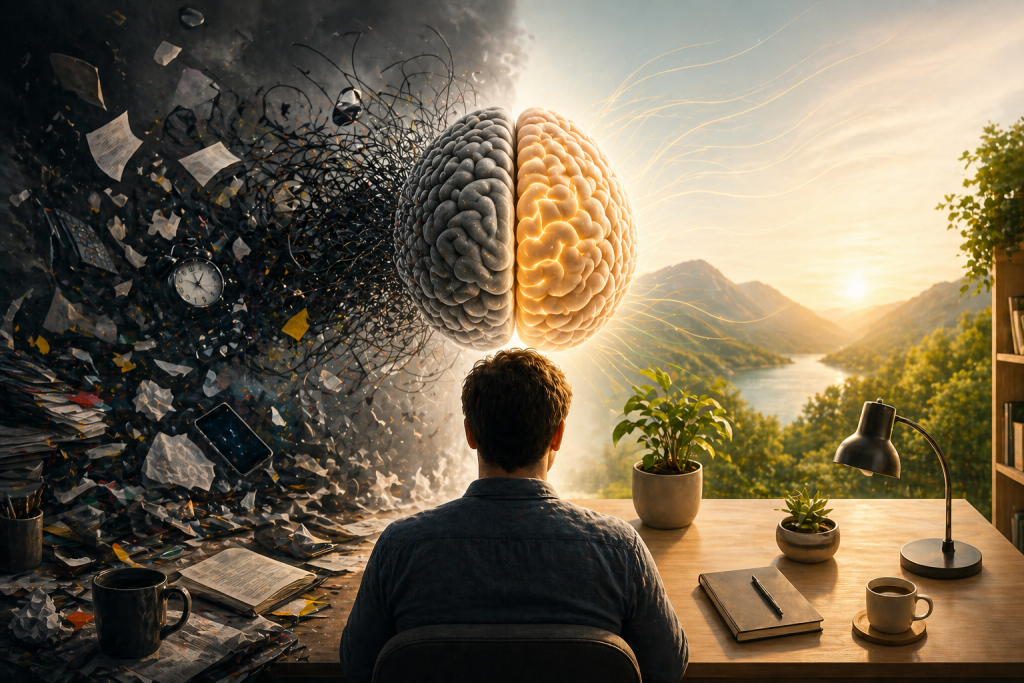
Attention-Deficit/Hyperactivity Disorder (ADHD) is often framed as a problem of attention, but in practice it is a condition of regulation. Regulation of attention, energy, motivation, and emotion. One of the most overlooked yet powerful levers in managing ADHD is environment.
A person with ADHD may struggle in one setting and perform exceptionally well in another. This is not random. It reflects how strongly the ADHD brain responds to external structure, stimulation, and clarity.
Understanding and optimizing environment is one of the highest return strategies for improving focus, productivity, and overall functioning, especially for adults navigating demanding professional lives.
The Science Behind ADHD and Environment
ADHD is associated with differences in dopamine signaling and executive function networks. These systems are responsible for motivation, planning, task initiation, and sustained attention.
What makes ADHD unique is that attention is not consistently impaired. It is context-dependent. When a task or environment provides sufficient interest, urgency, or novelty, performance improves. When it lacks these elements, even simple tasks can feel inaccessible.
Environment acts as an external regulator. It can either support or disrupt these systems. This is why two individuals with similar cognitive ability can have very different outcomes based on how their environment is designed.
The Five Environmental Drivers of ADHD Performance
Sensory Load
The ADHD brain is highly sensitive to incoming stimuli. Excessive noise, clutter, or visual chaos increases cognitive load and fragments attention. At the same time, environments that are too quiet or sterile may reduce engagement.
Optimal environments are controlled, not silent. Clean visual fields, consistent lighting, and intentional background sound create a stable baseline for focus.
Structure and Decision Clarity
Unstructured environments force the brain to constantly decide what to do next. For individuals with ADHD, this creates friction and leads to avoidance or task-switching.
Structure reduces the need for internal control. Clear schedules, defined priorities, and visible task systems allow attention to be directed rather than negotiated.
Stimulation Matching
ADHD is not a deficit of attention but a mismatch between task demands and stimulation level.
Low stimulation tasks lead to boredom and procrastination. High stimulation environments lead to overwhelm and shutdown.
High performance occurs when stimulation is calibrated. This can be achieved through timed work intervals, mild background input, and alternating between cognitive and physical tasks.
Social Context
Human presence influences attention. Supportive environments increase accountability and consistency, while unpredictable or critical environments increase stress and disengagement.
Even minimal social structure, such as working near others or having scheduled check-ins, can improve execution.
Digital Architecture
Modern digital environments are engineered for distraction. Notifications, social platforms, and constant switching between applications degrade attention quality.
Designing a focused digital environment is essential. This includes limiting notifications, reducing open tabs, and using intentional access to high-distraction platforms.
Designing an ADHD-Optimized Environment
Home Environment
The home should function as a system rather than a collection of spaces.
Create clear zones for work, rest, and recovery. Keep essential items visible and accessible to reduce friction. Use simple storage solutions that are easy to maintain over time.
Anchor the day with consistent routines, particularly in the morning and evening. These anchors stabilize attention and reduce decision fatigue.
Work Environment
High-performing individuals with ADHD often excel when their environment supports clarity and autonomy.
Use defined work blocks with a clear objective for each session. Break large tasks into smaller, visible steps. Externalize priorities through written systems rather than relying on memory.
Where possible, reduce interruptions and control the sensory environment through noise management or workspace selection.
Academic and Learning Environments
Learning environments should emphasize structure, repetition, and engagement.
Clear expectations, consistent feedback, and interactive formats improve retention and focus. Strategic breaks and movement enhance cognitive performance and reduce fatigue.
Lifestyle as an Environmental Layer
Environment is not limited to physical space. Biological and behavioral factors shape the internal environment of the brain.
Sleep
Sleep is foundational for attention regulation. Inconsistent or insufficient sleep amplifies ADHD symptoms and reduces cognitive flexibility.
A stable sleep schedule, reduced evening stimulation, and consistent wake times improve baseline functioning.
Nutrition
Stable energy supports stable attention. Irregular eating patterns or rapid blood sugar fluctuations can impair focus.
Balanced meals with adequate protein, healthy fats, and complex carbohydrates support sustained cognitive performance.
Movement
Physical activity enhances neurotransmitter balance and improves executive function.
Short, frequent movement throughout the day is often more effective than a single long session.
A Practical Framework for Immediate Improvement
Before increasing effort or relying on motivation, adjust the environment.
Ask the following:
- Is the task clearly defined
- Is the space visually simple
- Are distractions minimized
- Is the stimulation level appropriate
- Is there an external system supporting execution
If the answer to multiple questions is no, the issue is environmental, not personal.
Many individuals attempt to overcome ADHD through willpower alone. This approach is ineffective because it ignores how attention systems operate.
Other common issues include overcomplicated productivity systems, excessive multitasking, and neglect of sleep and physical health.
Simplicity and consistency outperform complexity.
ADHD is highly responsive to environment. When surroundings are aligned with how the brain regulates attention and motivation, performance improves naturally.
The most effective strategy is not to fight the brain, but to design conditions in which it can function optimally.
Small, intentional environmental changes can produce disproportionate improvements in focus, productivity, and mental clarity.
For busy professionals seeking clarity around focus, sleep, and performance, a structured and individualized approach can significantly accelerate results. Integrative psychiatric evaluation and targeted optimization can transform how attention and energy are managed in daily life.

Future Psychiatry is a concierge practice in New York City specializing in integrative psychiatry, anxiety treatment, and holistic mental health. Founded by Jafar Novruzov, PMHNP-BC, the clinic provides luxury, evidence-based psychiatric care designed for long-term wellness.