
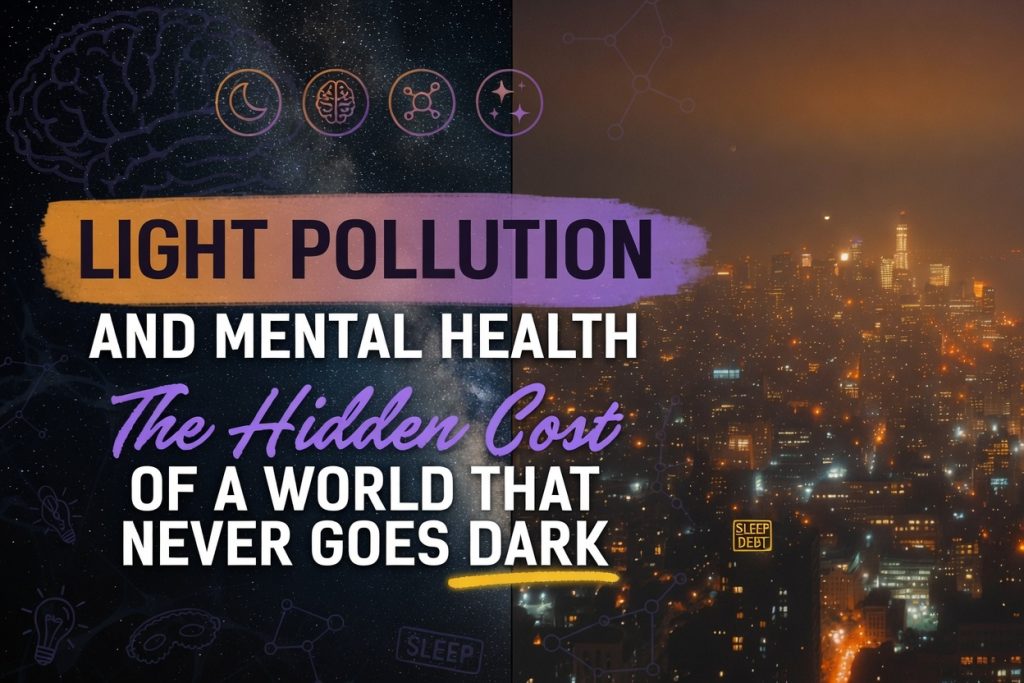
Look up at the night sky in New York City and you might see a handful of stars. In a truly dark rural sky, you would see thousands. This is not just an aesthetic loss. Light pollution and mental health are deeply linked, and the health effects of light pollution reach far beyond eye strain and a lost view of the Milky Way. As a psychiatric clinician, I increasingly see patients whose depression, anxiety, and insomnia are shaped by the artificial light they cannot escape. This guide covers what current science says about light pollution and sleep, artificial light and depression, blue light effects on health, and what you can actually do about it.
What Is Light Pollution, and How Bad Has It Gotten?
Light pollution refers to the excessive or misdirected artificial light produced by human activity, particularly at night. It includes sky glow (the halo of light over cities), glare, light trespass into homes, and the general erasure of natural darkness across most of the inhabited world.
The scale is staggering. More than 80 percent of the world’s population lives under light polluted skies, and roughly 99 percent of people in North America and Europe cannot see a truly dark night sky from where they live (DarkSky International). Satellite data shows that the artificially lit area of Earth’s surface increases by roughly 2 percent each year, with the brightness of that light growing at a similar rate.
Two shifts have accelerated the problem in the last 15 years:
- The global switch to LED lighting, which is cheaper and more efficient but often much bluer than the older warm bulbs it replaced.
- The saturation of homes with backlit screens, indoor overhead lighting used late into the evening, and 24 hour brightness in urban environments.
Your biology was calibrated over hundreds of thousands of years for sun by day, firelight in the evening, and near total darkness at night. That biology has not adapted to a world where the average person now gets more light after sunset than their great grandparents got at noon.
How Artificial Light Disrupts Your Biology
The primary mechanism is disruption of your circadian rhythm, the internal clock that regulates sleep, hormone release, body temperature, appetite, and mood across roughly a 24 hour cycle.
Specialized cells in your retina detect light, particularly blue wavelengths, and signal your brain’s master clock (the suprachiasmatic nucleus). When those cells detect bright light in the evening, several things happen:
- Melatonin production is suppressed, sometimes for hours.
- Cortisol, which should be low at night, stays elevated.
- Core body temperature does not drop as it should before sleep.
- Sleep onset is delayed and sleep architecture is disrupted, particularly REM sleep.
Blue light in the 460 to 480 nanometer range is the strongest suppressor of melatonin (Harvard Medical School on blue light). This is precisely the wavelength most common in LED bulbs, phone screens, computer monitors, and modern televisions. A brief evening exposure to bright blue enriched light can suppress melatonin by 50 percent or more and shift your circadian timing by an hour or two.
For people already prone to depression, anxiety, or insomnia, this disruption is not a mild inconvenience. It changes the biology of their condition.
Light Pollution and Mental Health
The clinical picture is now well documented across multiple large studies.
Depression. A growing body of research links higher outdoor and indoor light at night to increased risk of depression, both in adults and adolescents. One large study of over 85,000 adults found that people exposed to more light at night had significantly higher rates of major depressive disorder, along with anxiety, PTSD, and bipolar disorder (Nature Mental Health study, 2023). The association held even after adjusting for shift work, socioeconomic status, and daytime light exposure.
Anxiety. Chronic circadian disruption elevates baseline sympathetic nervous system activity. In plain language, you spend more of your day in a low grade fight or flight state, which shows up as irritability, muscle tension, difficulty relaxing, and increased startle response. If you are already anxious, artificial light at night makes it harder to come down.
Bipolar disorder. Circadian rhythm disruption is one of the most reliable triggers of manic and depressive episodes in bipolar disorder. Light exposure timing is now a first line consideration in chronotherapy for these patients.
Adolescent mental health. Teenagers are biologically inclined toward later circadian timing. Add in phone use late into the night, and the effect on mood, anxiety, and academic function is measurable. Studies link greater nighttime light exposure in adolescents to higher rates of self reported depression and anxiety symptoms.
Seasonal affective disorder. People who get too little bright light during the day and too much artificial light at night show the strongest seasonal mood patterns. The problem is often not just winter darkness. It is the compressed contrast between dim daytime indoor light and bright evening light.
If you are struggling with persistent mood or anxiety symptoms, our psychiatric evaluation services address these environmental factors alongside standard treatment.
The Physical Health Toll
Light pollution is not only a mental health issue. The same circadian disruption drives a long list of physical health consequences.
Poor sleep quality and duration. Even when total sleep time looks normal, artificial light at night fragments sleep architecture, particularly reducing REM sleep. If you want a deeper look at why this matters, our companion post on REM sleep and mental health covers it in detail.
Metabolic dysfunction. Circadian disruption is now recognized as a driver of insulin resistance, weight gain, and Type 2 diabetes risk. People who eat and are exposed to light on irregular schedules show worse metabolic outcomes even when calorie intake is controlled (NIH on circadian rhythms and metabolism).
Cardiovascular risk. Higher outdoor light at night correlates with elevated blood pressure and increased risk of stroke and coronary artery disease in population studies.
Cancer risk. The International Agency for Research on Cancer has classified shift work involving circadian disruption as a probable human carcinogen (Group 2A). The strongest evidence links nighttime light exposure to breast and prostate cancer, likely mediated by chronic melatonin suppression (IARC monograph).
Immune dysregulation. Melatonin is not just a sleep signal. It is a potent modulator of immune function and antioxidant activity. Chronically low nighttime melatonin has downstream effects on inflammation and immune response.
Reproductive health. Emerging research links disrupted circadian timing to menstrual irregularities and reduced fertility in both sexes.
Who Is Most Affected
Light pollution touches everyone, but some groups carry more of the burden.
Shift workers. Nurses, first responders, hospitality workers, warehouse staff. Their biology never gets a stable signal to lock onto, and the health consequences compound over years.
Urban residents. Especially those in apartments without blackout curtains, in neighborhoods with intense street lighting, or in high rises above the sky glow.
Adolescents and young adults. Their circadian systems are biologically more sensitive to evening light, and their nighttime device use is often the highest.
Older adults. Aging eyes let in less light overall, which paradoxically makes circadian signals weaker. This contributes to the fragmented sleep and mood changes common in later life.
People with existing mental health conditions. Depression, bipolar disorder, PTSD, and seasonal affective disorder are all sensitive to circadian disruption. Light pollution amplifies each of them.
10 Practical Recommendations You Can Start Tonight
None of these require moving to a rural area. They are the same interventions I discuss with patients.
1. Get bright light within 30 minutes of waking
Ten to fifteen minutes of outdoor light in the morning is the single most powerful anchor for your circadian rhythm. Even on cloudy days, outdoor light is dramatically brighter than typical indoor lighting (CDC on light and sleep).
2. Aggressively dim your environment after sunset
Turn off overhead lights in the evening. Use lamps at eye level or below. Choose warm bulbs in the 2000 to 2700K range. Your home should get progressively dimmer and warmer as the night goes on.
3. Install blackout curtains in your bedroom
Even small amounts of light entering the bedroom (street lights, neighboring windows, alarm clocks) suppress melatonin and fragment sleep. True blackout is worth the investment.
4. Cover or remove indicator lights
Small LED indicators on chargers, routers, and appliances add up. Cover them with black tape or move them out of the bedroom.
5. Shift device screens to warm mode in the evening
Every major phone and computer has a night mode or warm color setting. Turn it on and set it to activate two to three hours before bed. This does not fully eliminate the effect but reduces it substantially.
6. Stop scrolling in bed
The evidence is unusually clear on this one. Bed should be for sleep. If you cannot fall asleep without your phone, the phone is likely part of why you cannot fall asleep.
7. Wear blue blocking glasses if you must be on screens late
For people who genuinely cannot avoid evening screen work, amber tinted glasses in the two to three hours before bed can meaningfully reduce melatonin suppression. Look for glasses that block at least the 460 to 480 nanometer range.
8. Get outside during the day, not just for a walk to your car
Total daytime light exposure matters. People who spend their entire day in offices lit at 300 to 500 lux and then encounter bright evening light have essentially the opposite of what their biology expects.
9. Advocate for better outdoor lighting
Fully shielded fixtures, warmer color temperatures, motion sensors, and lower intensity streetlights make a real difference for entire neighborhoods. Your municipality likely has a public comment process. Communities that push for smarter lighting see measurable reductions in sky glow (DarkSky International lighting guidance).
10. Take periodic trips to darker skies
If you can spend a few nights per year in a genuinely dark location, your circadian system will thank you. Beyond the biology, seeing a truly dark sky tends to reset something psychological as well.
When Professional Support Helps
Environmental changes are powerful, but sometimes they are not enough. Consider speaking with a psychiatric clinician if:
- Depression, anxiety, or insomnia have lasted more than a few weeks despite lifestyle changes
- You work night shifts and feel your mental health suffering
- You have a bipolar disorder diagnosis and want help managing light exposure as part of episode prevention
- You have seasonal mood patterns that are getting harder to manage
- You suspect an underlying condition is compounding the effect of your environment
At Future Psychiatry PLLC, I integrate circadian and environmental assessment into psychiatric care for adult patients in New York. Schedule an initial consultation here or contact us with questions.
Frequently Asked Questions
Does light pollution really cause depression, or is it just correlated? The most rigorous studies control for confounding factors like shift work, income, and daytime light. Even after those adjustments, a strong association between nighttime light exposure and depression remains. Combined with clear biological mechanisms (melatonin suppression, circadian disruption), the evidence points to a causal role, not just correlation.
Are blue light blocking glasses actually useful? For evening screen use, moderately yes. They reduce melatonin suppression and can improve sleep onset. They do not help with eye strain in the way the marketing sometimes claims, and they are not a substitute for turning off screens entirely.
Is any light exposure at night harmful, or does intensity matter? Intensity, timing, and wavelength all matter. A dim red night light in the hallway is essentially harmless. A bright bathroom light or a phone screen in bed is not. Even relatively low levels of blue enriched light can shift circadian timing.
Can I make up for evening light exposure with more morning light? Partially. Bright morning light strengthens circadian signaling and makes you somewhat more resilient to evening light. It does not fully neutralize the effect, but it helps significantly.
Does city living cause depression? Urban environments are associated with higher rates of some mental health conditions, and light pollution is likely part of the mechanism. Other contributors include noise, air pollution, reduced access to nature, and social density. You do not have to move to the countryside to improve your circadian health, but you do need to be deliberate about the light in your immediate environment.
Are red night lights safe for the bedroom? Yes. Red light in the 600 to 700 nanometer range has minimal effect on melatonin production and is a reasonable choice for hallways, bathrooms, and children’s bedrooms if some illumination is needed at night.
This article is for educational purposes and does not constitute medical advice. If you are concerned about your sleep, mood, or overall health, please consult a qualified healthcare provider.
About the author: Jafar Novruzov is a board certified Psychiatric Mental Health Nurse Practitioner and the founder of Future Psychiatry PLLC, a psychiatric practice serving adults in New York.

Future Psychiatry is a concierge practice in New York City specializing in integrative psychiatry, anxiety treatment, and holistic mental health. Founded by Jafar Novruzov, PMHNP-BC, the clinic provides luxury, evidence-based psychiatric care designed for long-term wellness.