
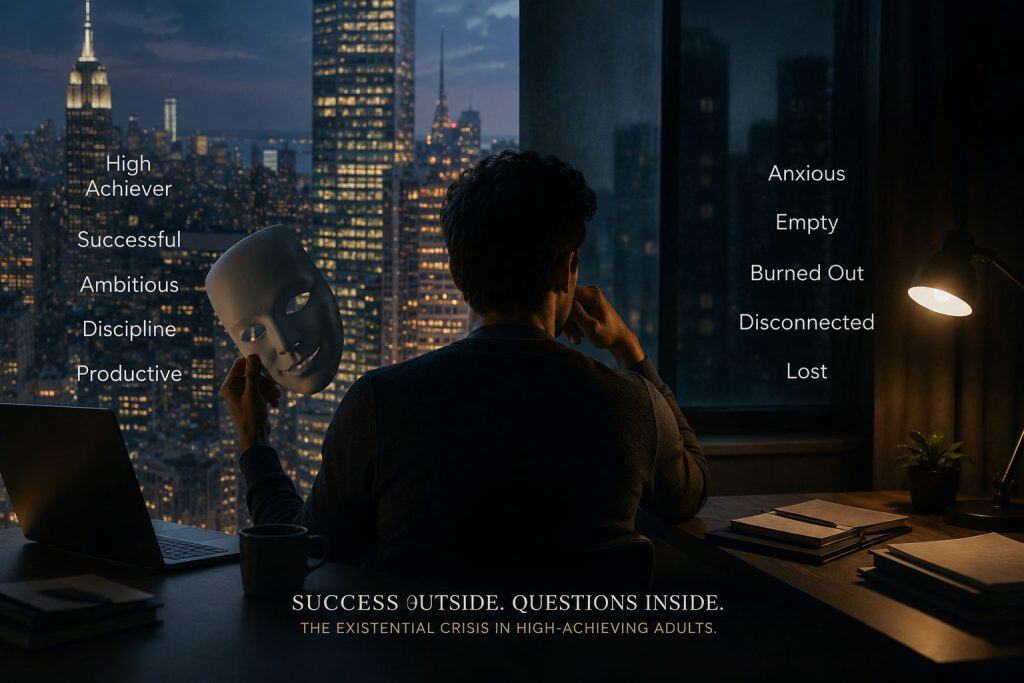
A pattern I increasingly see in high-achieving adults in their 20s and 30s is this:
Externally, life looks relatively stable. They may have a strong career trajectory, advanced degree, ambitious goals, or a lifestyle that appears successful from the outside. But internally, they feel emotionally disconnected, chronically anxious, burned out, or unsure whether the life they built actually feels meaningful.
A lot of people describe it as:
“I worked so hard to get here, so why do I still feel unhappy?”
This is often described online as a “quarter-life crisis,” but clinically it is usually more nuanced than social media makes it seem.
What Is an Existential Crisis?
An existential crisis is a period of intense questioning related to identity, meaning, purpose, direction, or authenticity.
It commonly appears during periods of transition or prolonged stress, especially in people whose identity became heavily connected to achievement and productivity.
Importantly, existential distress is not always the same thing as major depressive disorder. Many people experiencing existential crises continue functioning at a high level professionally while privately struggling emotionally.
Why High Achievers Are More Vulnerable
Many high-achieving individuals learned early in life that performance led to validation, safety, praise, or self-worth.
Over time, the nervous system can begin associating productivity with identity. Achievement temporarily reduces anxiety, but it does not necessarily create long-term emotional fulfillment or psychological stability.
Research in psychology consistently shows that long-term well-being is more strongly associated with:
- meaningful relationships
- emotional connection
- sleep quality
- physical health
- psychological flexibility
- community
- purpose
Not achievement alone.
A lot of ambitious people spend years optimizing their resume, career, or income while unintentionally neglecting recovery, emotional connection, and nervous system regulation.
Eventually, the body and mind start signaling that something internally is misaligned.
Common Symptoms of Existential Crisis
Existential crisis in high-achieving adults often presents subtly.
People may continue functioning well professionally while privately experiencing:
- emotional numbness
- chronic overthinking
- anxiety about the future
- burnout
- insomnia
- constant comparison to others
- difficulty enjoying accomplishments
- feeling disconnected from their own life
- a persistent feeling that “something is missing”
Some people begin questioning their career direction repeatedly despite objective success. Others feel emotionally exhausted but unable to slow down without guilt.
Many describe feeling trapped in chronic “performance mode.”
Burnout, Sleep, and Nervous System Dysregulation
One of the biggest misconceptions is that existential crisis is purely philosophical.
Physiology matters significantly.
Chronic stress, sleep deprivation, circadian disruption, excessive screen exposure, and persistent nervous system hyperactivation all affect:
- emotional resilience
- anxiety regulation
- cognitive flexibility
- motivation
- emotional processing
A chronically dysregulated nervous system changes how people experience life psychologically. Everything can begin feeling flatter, heavier, or emotionally distant.
This is one reason burnout and existential anxiety frequently overlap.
Sleep disruption alone can worsen emotional regulation, increase anxiety, reduce stress tolerance, and intensify feelings of hopelessness or disconnection.
How Social Media Intensifies Emotional Exhaustion
Humans were not psychologically designed to compare themselves to hundreds of people daily.
Many ambitious young adults now exist in a constant cycle of comparison, optimization, and pressure to continuously improve. Social media creates unrealistic expectations that people should always feel motivated, purposeful, attractive, productive, and emotionally fulfilled.
Over time, this creates chronic psychological pressure and a persistent fear of “falling behind.”
Even objectively successful individuals can begin feeling like they are failing internally.
Existential Crisis vs Depression
Existential crisis and depression overlap, but they are not identical.
Depression commonly includes persistent low mood, hopelessness, loss of pleasure, and impaired functioning.
Existential distress is usually more centered around meaning, identity, direction, emotional disconnection, and chronic internal dissatisfaction despite external functioning.
Some people experience both simultaneously.
This distinction matters clinically because treatment approaches may differ.
Evidence-Based Approaches That Help
There is no single “quick fix,” but clinically effective approaches often include improving sleep quality, reducing chronic overstimulation, addressing perfectionism and achievement-based self-worth, strengthening emotional connection and relationships, and developing meaning outside of productivity alone.
For many people, deeper psychological work is required because intellectually understanding these concepts is very different from emotionally feeling safe without constant achievement.
In some cases, professional support is important, especially when existential distress overlaps with:
anxiety disorders
ADHD
depression
insomnia
burnout
trauma-related patterns
chronic emotional dysregulation
Final Thoughts
A lot of intelligent and ambitious people quietly believe:
“I should feel happier by now.”
But psychological well-being is not built through achievement alone.
Humans also need rest, connection, emotional safety, meaning, authenticity, and recovery.
Sometimes an existential crisis is not a sign that your life is falling apart. Sometimes it is a signal that your nervous system and identity have been organized around performance for too long without enough balance or emotional grounding.
At Future Psychiatry, we work with busy professionals struggling with anxiety, burnout, sleep disruption, ADHD, identity stress, and high-functioning emotional exhaustion using evidence-based and integrative psychiatric care.

Future Psychiatry is a concierge practice in New York City specializing in integrative psychiatry, anxiety treatment, and holistic mental health. Founded by Jafar Novruzov, PMHNP-BC, the clinic provides luxury, evidence-based psychiatric care designed for long-term wellness.