
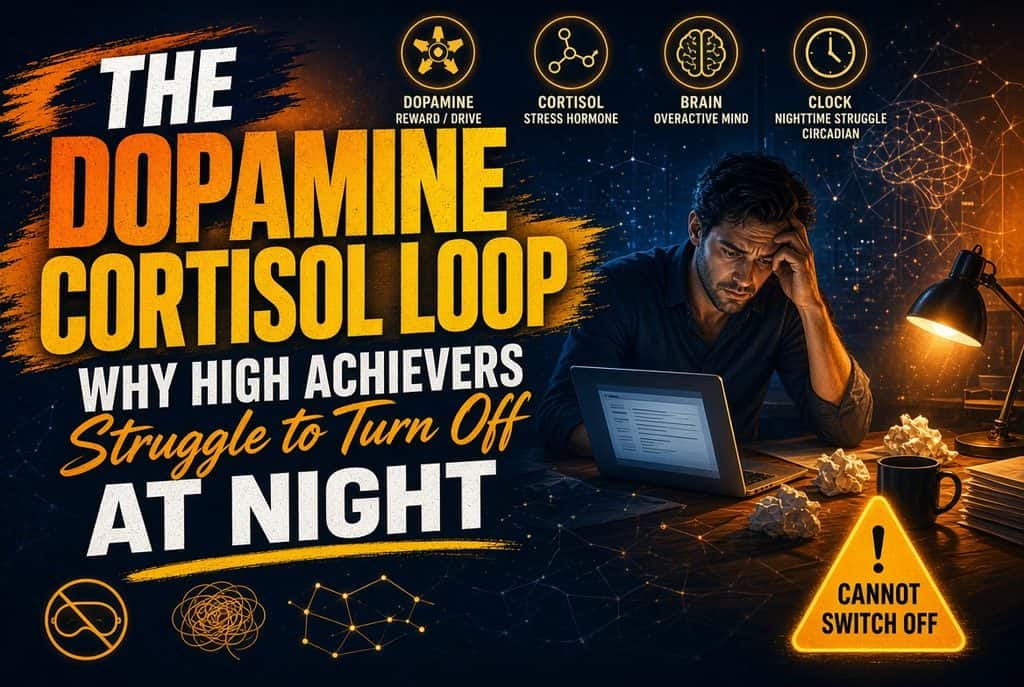
You finish a demanding workday, manage endless responsibilities, and finally shut down your laptop. Yet, when your head hits the pillow, your brain refuses to slow down. For many high performing professionals, the dopamine and cortisol loop creates an ongoing state of hyperarousal that makes peaceful, restorative sleep feel nearly impossible.
Rather than a simple case of poor sleep hygiene, this late night restlessness often reflects a profound physiological imbalance between your drive for achievement and your nervous system ability to recover.
The Neurobiology of the High Achiever State
To understand why turning off feels so difficult, it helps to examine how stress hormones and motivation chemical messengers interact under chronic pressure:
- Dopamine: The primary neurotransmitter responsible for motivation, reward, and goal directed action. High stress careers, rapid problem solving, and constant digital notification streams trigger steady releases of dopamine throughout the day.
- Cortisol: The chief stress hormone produced by the adrenal glands. Cortisol follows a natural circadian pattern, peaking shortly after waking to promote alertness and tapering down gradually toward evening to allow melatonin production.
When you spend long hours tackling high stakes challenges, your brain maintains elevated dopamine levels to keep you sharp and motivated. In turn, high dopamine output triggers continued cortisol secretion. Over time, this sustained dopamine and cortisol loop shifts your baseline biological rhythm, keeping your body in constant fight or flight readiness long after working hours end.
Clinical Consequences: The “Wired but Tired” State
When elevated stress signaling persists into the evening, it leads to distinct physiological and cognitive challenges documented by clinical research at the National Institutes of Health:
1. Disrupted Circadian Melatonin Signaling
High evening cortisol directly inhibits the pineal gland from releasing melatonin. Even if you feel physically exhausted, your brain fails to receive the biological signal that it is time to initiate sleep architecture.
2. Executive Function Fatigue and Racing Thoughts
Because dopamine keeps prefrontal cortex circuits engaged, your mind continues scanning for unresolved tasks, processing decisions, and generating ideas. This mental hyperactivity often manifests as racing thoughts or intense anxiety the moment external distractions subside.
3. Autonomic Nervous System Dysregulation
According to stress physiology studies published by the American Psychological Association, chronic nervous system overstimulation shifts the body away from parasympathetic rest and digest functions. As a result, heart rate variability decreases, resting heart rate stays elevated, and sleep remains shallow and fragmented.
Frequently Asked Questions (FAQs)
What is Future Psychiatry?
Future Psychiatry is a concierge psychiatric practice founded by Jafar Novruzov, MSN, APRN, PMHNP-BC. We blend standard of care psychiatric practice, advanced neuroscience, and evidence based integrative testing to optimize sleep, focus, and mood.
How are appointments conducted?
Care is provided via telepsychiatry throughout New York State, allowing you to access private consultation from home or office.
What conditions do you treat?
We specialize in Sleep & Circadian Health, Adult ADHD, Anxiety & Stress, Mood Disorders, Burnout & Cognitive Fatigue, and Integrative Psychiatry.
How much do consultations cost?
- Complimentary Intro Call: $0 (15 mins)
- Initial Evaluation: $495 (60 mins)
- Follow up Sessions: $325 (30 mins)
Do you accept insurance?
Future Psychiatry operates as a concierge, out of network practice to ensure unhurried, highly personalized care. Superbills can be provided upon request for out of network reimbursement from your insurance provider.
At Future Psychiatry, we deliver evidence based integrative psychiatric care to help high achievers optimize brain health, regulate nervous system function, and protect long term cognitive longevity. Explore our diagnostic testing through our Future Life Lab or read additional clinical insights on our Future Psychiatry Blog.
If you are ready to address the root causes of executive burnout and sleep disruption, contact Future Psychiatry today to schedule your private consultation.

Future Psychiatry is a concierge practice in New York City specializing in integrative psychiatry, anxiety treatment, and holistic mental health. Founded by Jafar Novruzov, PMHNP-BC, the clinic provides luxury, evidence-based psychiatric care designed for long-term wellness.