
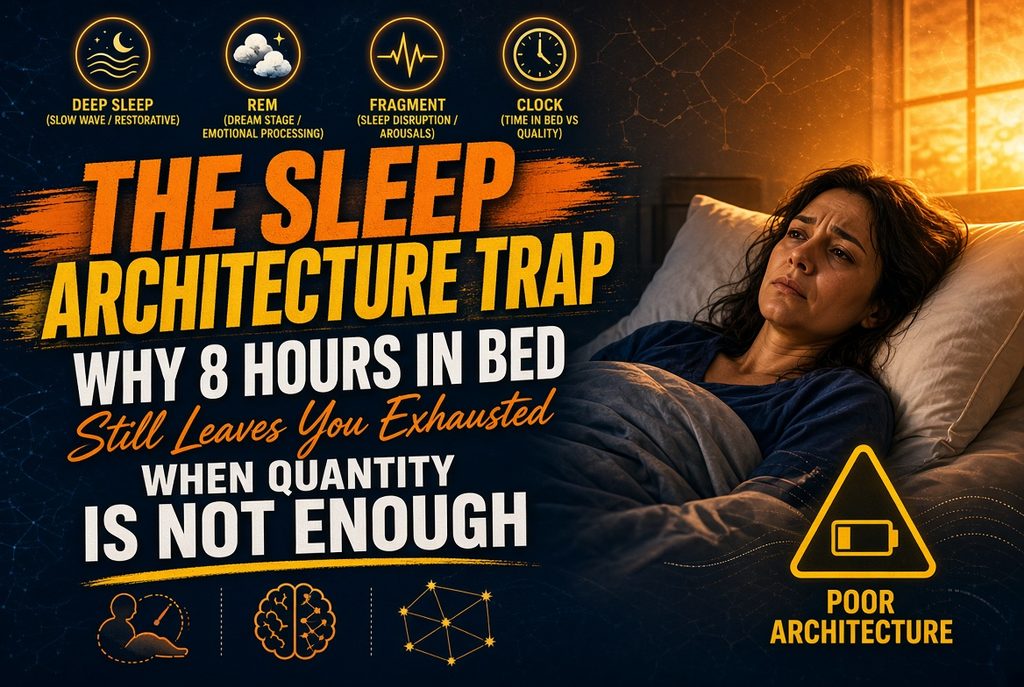
You went to bed at a reasonable hour, stayed asleep for eight full hours, and woke up to your alarm. Yet the moment your feet hit the floor, your body feels heavy, your mind feels clouded, and you reach for a stimulant just to start the day. For many high achieving professionals, this frustrating disconnect between total sleep time and actual daytime energy highlights the complex link between sleep architecture and fatigue.
Total time spent in bed is only part of the biological equation. What truly dictates your daytime focus, emotional steadiness, and mental sharpness is sleep architecture, the precise progression of cycles and stages your brain must traverse each night.
Understanding Sleep Architecture: Stages vs Duration
Sleep is not a uniform state of rest. A restorative night consists of four to six ninety minute cycles, each containing specific non rapid eye movement (NREM) stages and rapid eye movement (REM) sleep:
- Stage N1 and N2 (Light Sleep): Serves as the transitional bridge from wakefulness, downshifting your heart rate, respiration, and brainwave speed.
- Stage N3 (Slow Wave Deep Sleep): The biological repair phase. During deep slow wave sleep, the brain activates the glymphatic system, a waste clearance network that flushes metabolic debris like beta amyloid out of neural pathways. Human growth hormone surges, muscle tissue repairs, and the immune system recharges.
- REM Sleep: The cognitive processing and emotional regulation phase. During REM, your brain integrates procedural memory, consolidates learning, and resolves emotional stressors from waking hours.
According to clinical research from the National Institutes of Health, missing out on slow wave deep sleep leaves your brain physically unrefreshed, while shortened REM sleep impairs next day working memory and mood resilience.
What Disrupts Sleep Architecture Without Waking You Up?
Many individuals experience fragmented sleep architecture without ever realizing they are waking up. Several common lifestyle and biological factors silently erode deep and REM stages:
- Evening Alcohol: While a drink before bed may induce drowsiness, alcohol severely suppresses REM sleep and fragments sleep continuity during the second half of the night.
- Late Caffeine Intake: Caffeine blunts adenosine signaling, delaying transition into slow wave sleep and reducing deep sleep percentage even if you fall asleep on time.
- Chronic Cortisol Elevation: Sustained evening stress signals tell the autonomic nervous system to stay alert, keeping the brain locked in lighter N1 and N2 stages rather than transitioning into Stage N3.
- Artificial Blue Light: Late screen exposure delays melatonin release, pushing back circadian sleep timing and truncating restorative morning REM cycles.
Research published by the American Academy of Sleep Medicine emphasizes that architectural disruption often mimics primary mood disorders, producing persistent cognitive slowing, irritability, and low motivation.
Frequently Asked Questions (FAQs)
What is Future Psychiatry?
Future Psychiatry is a concierge psychiatric practice founded by Jafar Novruzov, MSN, APRN, PMHNP BC. We blend standard of care psychiatric practice, advanced neuroscience, and evidence based integrative testing to optimize sleep, focus, and mood.
How are appointments conducted?
Care is provided via telepsychiatry throughout New York State, allowing you to access private consultation from home or office.
What conditions do you treat?
We specialize in Sleep & Circadian Health, Adult ADHD, Anxiety & Stress, Mood Disorders, Burnout & Cognitive Fatigue, and Integrative Psychiatry.
How much do consultations cost?
- Complimentary Intro Call: $0 (15 mins)
- Initial Evaluation: $495 (60 mins)
- Follow up Sessions: $325 (30 mins)
Do you accept insurance?
Future Psychiatry operates as a concierge, out of network practice to ensure unhurried, highly personalized care. Superbills can be provided upon request for out of network reimbursement from your insurance provider.
Can wearable sleep trackers accurately diagnose disrupted sleep architecture?
While commercial trackers offer helpful insights into trends and general wake cycles, they approximate sleep stages based on movement and heart rate variability rather than direct EEG brainwave monitoring. A comprehensive clinical evaluation is essential for diagnosing persistent sleep architecture disorders.
Restore Restorative Sleep with Future Psychiatry
Waking up exhausted after a full night in bed is not a personal failure or something you have to accept as part of a busy life. When sleep architecture is restored, daytime focus, memory, and emotional balance follow naturally.
At Future Psychiatry, we evaluate sleep through a precision, integrative lens, identifying circadian, neurochemical, and metabolic disruptors that prevent deep cellular recovery. Explore our diagnostic testing through our Future Life Lab page or read more on our Future Psychiatry Blog.
If you are ready to wake up feeling truly restored, contact Future Psychiatry today to schedule your private consultation.

Future Psychiatry is a concierge practice in New York City specializing in integrative psychiatry, anxiety treatment, and holistic mental health. Founded by Jafar Novruzov, PMHNP-BC, the clinic provides luxury, evidence-based psychiatric care designed for long-term wellness.