
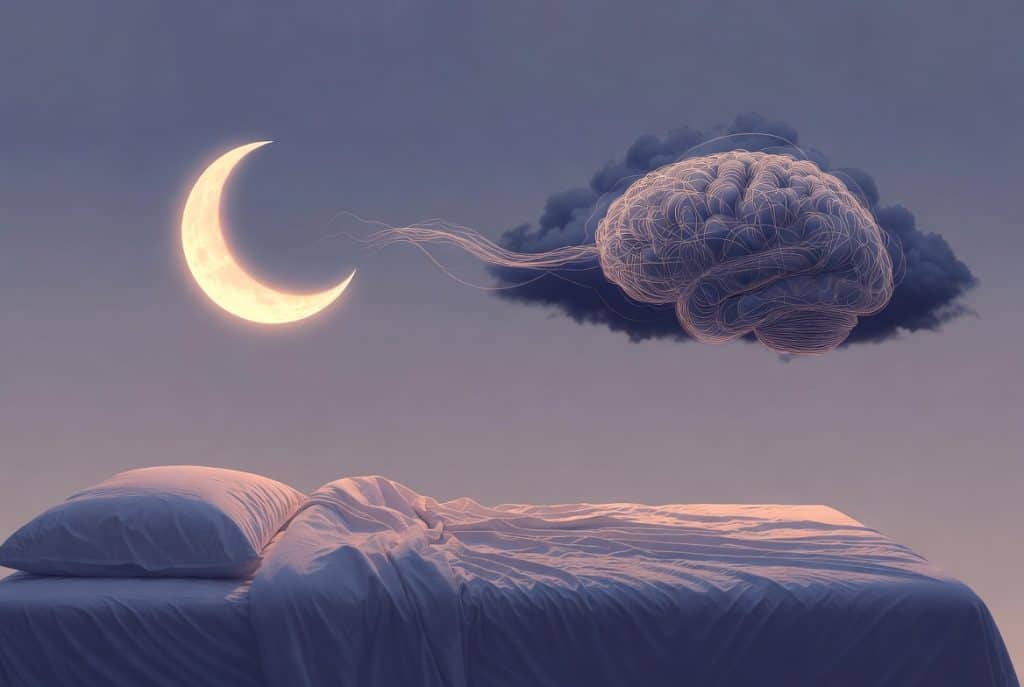
There is something uniquely exhausting about lying awake night after night, your mind refusing to quiet down no matter how tired your body feels. For many people, struggling to sleep is not just a physical inconvenience. It is often one of the earliest and most persistent signs that something deeper is happening with their mental health. The relationship between sleep problems and mental health is real, it runs in both directions, and it deserves far more attention than it usually gets.
Why Sleep and Mental Health Are So Closely Linked
Most people know that a bad night’s sleep leaves them feeling irritable, foggy, and emotionally flat. But when poor sleep becomes a pattern, the effects go much further. Sleep is the time when your brain processes emotions, consolidates memories, and restores the chemical balance that keeps your mood stable. When that process is disrupted night after night, everything starts to unravel a little.
Research from the National Institute of Mental Health consistently shows that sleep disturbances are present in nearly every major mental health condition. This does not mean poor sleep causes mental illness, but it does mean that the two are deeply intertwined. Treating one without addressing the other often leads to incomplete recovery.
The connection also runs the other way. Anxiety can make it nearly impossible to fall asleep because an anxious mind keeps rehearsing worst-case scenarios. Depression often brings either too much sleep or very little of it, both of which reinforce the low energy and hopelessness that make depression so hard to shake. Understanding this cycle is the first step toward breaking it.
What Sleep Problems Look Like in Practice
Sleep problems and mental health issues share a lot of surface-level symptoms, which is part of what makes them so easy to overlook or misattribute. Someone dealing with poor sleep might notice trouble concentrating, a short fuse, increased appetite for carbohydrates or sugar, and a creeping sense of hopelessness that feels disproportionate to their circumstances.
You might find yourself going to bed exhausted but lying awake for hours. You might wake up multiple times during the night feeling anxious without quite knowing why. Some people sleep long hours and still wake up feeling completely drained. These patterns are not character flaws or signs of weakness. They are symptoms, and they are worth taking seriously.
The National Alliance on Mental Illness notes that people with mental health conditions are significantly more likely to experience chronic sleep problems than the general population, and that addressing sleep is often a key part of psychiatric treatment.
When It Is More Than Just a Bad Habit
It is easy to chalk sleep trouble up to too much screen time, too much coffee, or a stressful week. And sometimes that is exactly what it is. But if you have been struggling with your sleep for more than a few weeks, if it is affecting your work, your relationships, or your sense of yourself, it is worth pausing to consider whether something more is going on.
Signs that your sleep problems may be connected to an underlying mental health concern include: waking up with a sense of dread that has no clear cause, feeling emotionally numb or disconnected after nights of disrupted rest, noticing that your anxiety peaks sharply at bedtime, or experiencing racing thoughts that seem impossible to slow down. These are the kinds of experiences that a psychiatrist is specifically trained to evaluate and address.
The American Psychological Association emphasizes that sleep is not a passive process. It is an active, essential part of emotional regulation and mental wellness, and disruptions to it are legitimate medical concerns rather than lifestyle inconveniences.
How Psychiatric Care Addresses Sleep
When someone comes in struggling with sleep, a good psychiatric evaluation looks at the full picture. Are there symptoms of anxiety or depression that are driving the sleep difficulty? Is the poor sleep itself worsening mood and concentration, creating a cycle that has become hard to escape? Are there medical factors, medications, or life circumstances contributing to the pattern?
From there, treatment might involve therapy approaches like cognitive behavioral therapy for insomnia, medication adjustments, or working through the underlying anxiety or depression that is keeping sleep out of reach. The goal is not just to get someone to sleep through the night. It is to address what is underneath the sleeplessness so that both the mental health and the sleep improve together.
Sleep problems and mental health often feed each other in ways that are hard to untangle alone. That is exactly the kind of complexity that psychiatric care is designed to navigate.
You Do Not Have to Keep Running on Empty
If you have been pushing through exhaustion and hoping things will eventually sort themselves out, know that help is available and that you do not have to figure this out on your own. Future Psychiatry offers thoughtful, personalized psychiatric care for people dealing with anxiety, depression, sleep difficulties, and the many ways those experiences overlap.
You can learn more about what Future Psychiatry offers at futurepsychiatry.com, and when you are ready to take the next step, reaching out is simple at futurepsychiatry.com/contact. Rest is possible, and so is feeling like yourself again.
Future Psychiatry serves patients seeking compassionate, evidence-based psychiatric care. Personalized mental health treatment that is accessible and truly effective.

Future Psychiatry is a concierge practice in New York City specializing in integrative psychiatry, anxiety treatment, and holistic mental health. Founded by Jafar Novruzov, PMHNP-BC, the clinic provides luxury, evidence-based psychiatric care designed for long-term wellness.