
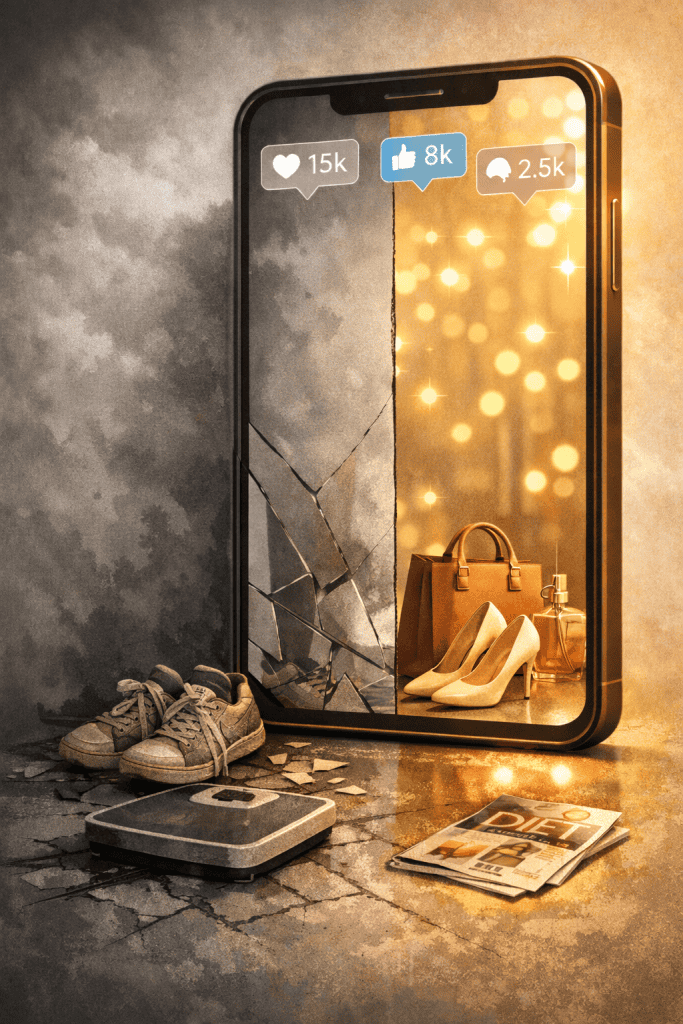
Social media didn’t create insecurity but it has certainly amplified it.
In clinical practice, I often meet people who appear stable and successful on the surface yet describe a growing sense of self-doubt, dissatisfaction with their bodies, or persistent internal pressure that feels difficult to name. They’re working, maintaining relationships, and meeting responsibilities but something inside feels increasingly unsettled.
The common thread is rarely a single event. It’s prolonged exposure to social media.
The brain’s comparison system is ancient but the stimulus is not.
Human brains evolved in small social groups where comparison served a purpose as belonging, safety, and social learning. That system was never meant to process thousands of curated images, achievements, and bodies every week.
Social media turns an adaptive mechanism into a chronic stressor.
Instead of comparing ourselves to a few peers, we’re repeatedly exposed to:
- Idealized appearance
- Selectively shared success
- Performative intimacy
- Metrics that equate visibility with value
Neuroscience research shows that repeated upward comparison activates threat-related neural circuits, particularly when identity, appearance, or status are involved. Over time, this subtly reshapes self-perception not through conscious belief, but through emotional conditioning.
Body image is not just visual — it’s physiological
Body image distress is often framed as a cognitive issue. Clinically, it behaves more like a regulatory one.
Chronic comparison increases:
- Baseline stress hormones
- Vigilance toward perceived flaws
- Reduced ability to feel grounded inside the body
This explains why reassurance or insight alone rarely resolves the problem. Many people understand that images are filtered, staged, or edited but yet still feel worse afterward. The gap between knowing and feeling is where psychiatry needs to look more closely.
A real-world clinical pattern
Consider an adult in their early 30s who is performing well at work, socially engaged, and generally physically healthy. There’s no clear psychiatric history and no obvious crisis.
Yet they report:
- New dissatisfaction with their appearance
- A sense of falling behind despite objective stability
- Difficulty enjoying social situations
- Increased self-monitoring and comparison
There is no single trigger. Instead, what emerges is years of daily comparison without recovery.
When social media exposure is reduced, sleep depth improves, stress physiology is addressed, and real-world feedback loops are restored, these symptoms often soften without directly targeting “confidence” or “self-esteem.”
Why this matters for modern psychiatry
Much of mental health care waits for distress to become diagnosable.
But social media–related self-doubt rarely presents as a clear disorder. It shows up as identity becoming externally referenced and self-trust weakening quietly.
Preventive and integrative psychiatry pays attention earlier:
- How comparison affects sleep architecture
- How chronic stress alters body perception
- How environment shapes internal narrative over time
This isn’t about rejecting technology. It’s about recognizing that brains need recovery from comparison just as bodies need recovery from strain.
Reframing the conversation
The goal is to restore balance.
When people rebuild:
- Internal reference points
- Physical presence
- Nervous system regulation
- Offline feedback and connection
Their self-image often stabilizes.
At Future Psychiatry, we view concerns like body image and self-doubt not as superficial issues, but as signals of how modern environments interact with human biology. When the system is supported, symptoms often follow.

Future Psychiatry is a concierge practice in New York City specializing in integrative psychiatry, anxiety treatment, and holistic mental health. Founded by Jafar Novruzov, PMHNP-BC, the clinic provides luxury, evidence-based psychiatric care designed for long-term wellness.