
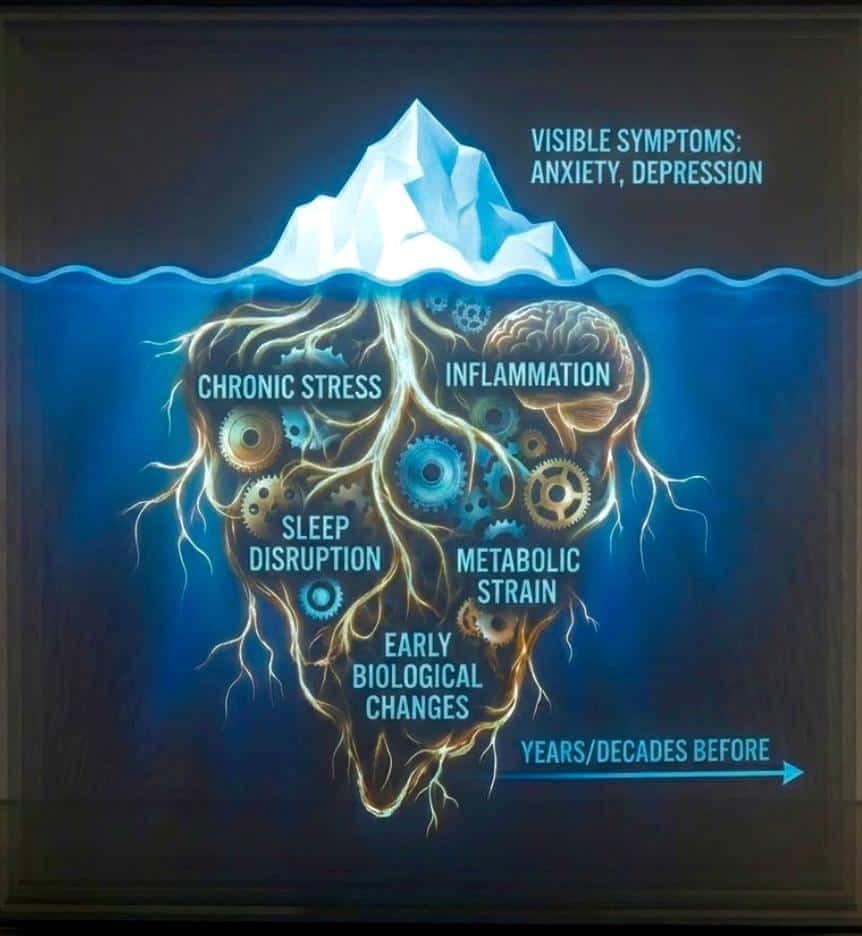
Many people view mental health struggles as sudden disruptions, but a deeper look at the biological origins of symptoms reveals that the body has often been compensating for years. Long before a diagnosis is made, our nervous systems and metabolic pathways adapt to chronic strain. By understanding the biological origins of symptoms, we can shift from reactive crisis management to proactive, trajectory-aware care.
Most people think of mental health symptoms as a starting point.
Anxiety appears. Sleep breaks down. Mood shifts. Then care begins.
From a biological perspective, symptoms are rarely the beginning.
They are often the final signal in a much longer process — one that unfolds quietly over years, sometimes decades. Long before someone meets criteria for a diagnosis, the nervous system is adapting to chronic stress, disrupted sleep, inflammation, metabolic strain, and cognitive overload.
The body compensates remarkably well. Until it doesn’t.
In psychiatry, we are trained to treat what is visible: panic, depression, insomnia, irritability. But emerging research across neuroscience, psychoneuroimmunology, and longevity science consistently shows that mental health trajectories are shaped far earlier than symptom onset.
Sleep architecture changes before mood does.
Stress hormones shift before anxiety becomes conscious.
Inflammatory patterns can precede depressive symptoms.
By the time someone says, “I don’t feel like myself anymore,” their system has often been working overtime for a long time.
This matters because late intervention limits options. When care begins only after symptoms become disruptive, treatment often feels reactive. Patients may blame themselves for not responding quickly enough, or assume something is “wrong” with them when progress is slow.
Preventive psychiatry takes a different view.
Instead of asking only “What symptoms are present?” it asks:
- What patterns have been forming?
- How long has the nervous system been under strain?
- What biological systems have been compensating quietly?
This approach does not pathologize normal stress or emotion. It contextualizes them. It treats mental health as a dynamic, biological process rather than a sudden failure.
For many people, relief begins not when symptoms disappear, but when their experience finally makes sense.
Understanding that symptoms often appear late — and biology starts much earlier — shifts psychiatry from crisis response to trajectory awareness. And that shift changes everything about how care is delivered, timed, and experienced.

Future Psychiatry is a concierge practice in New York City specializing in integrative psychiatry, anxiety treatment, and holistic mental health. Founded by Jafar Novruzov, PMHNP-BC, the clinic provides luxury, evidence-based psychiatric care designed for long-term wellness.